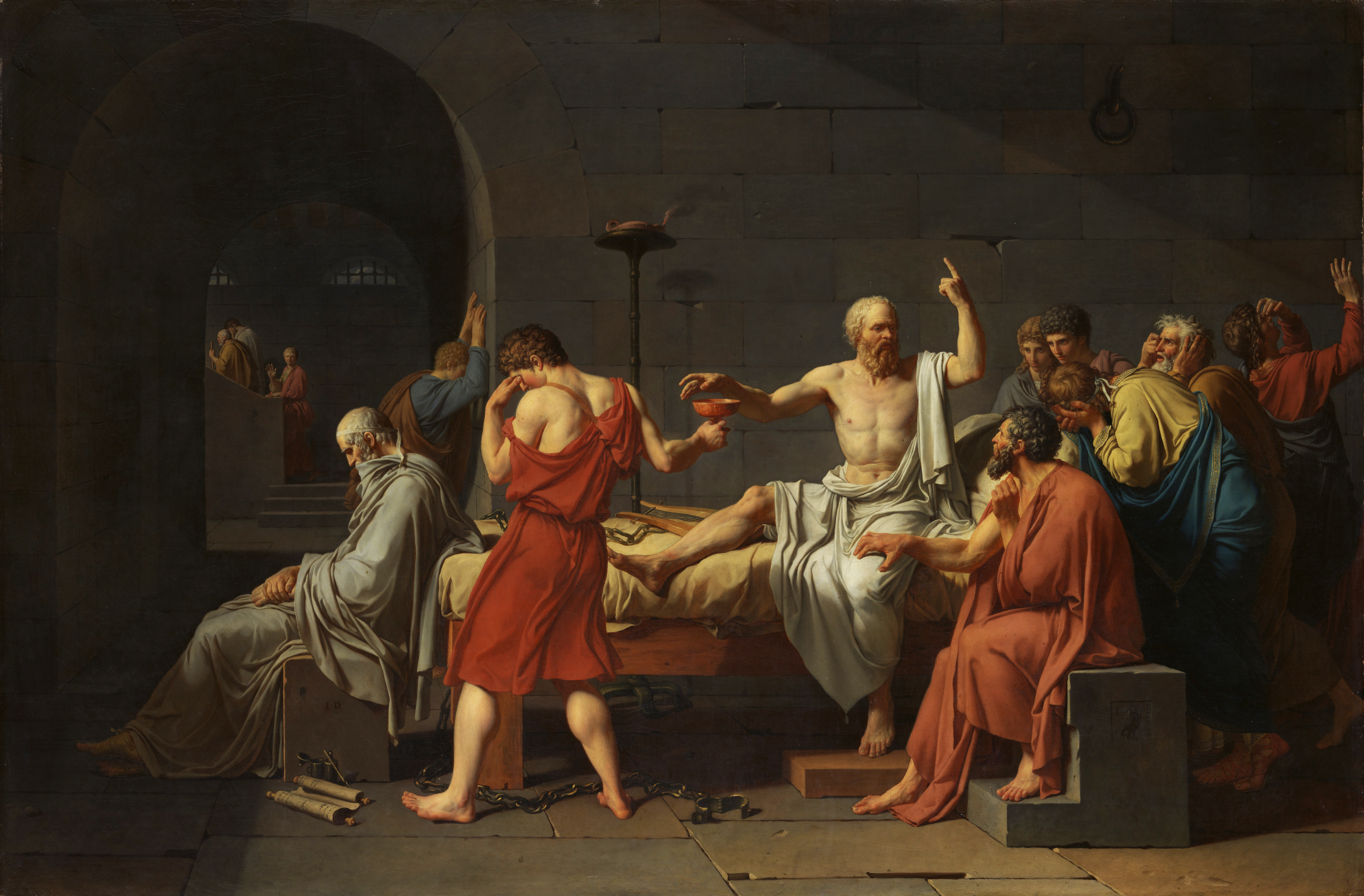
 Condemned to death or exile by the Athenian government for his teaching methods, Socrates rejected exile and accepted death by hemlock.
This work contrasts the energetic but controlled Socrates with his swooning disciples: the philosopher’s body is constructed on straight lines; the students’, curves. Note that, though the cup of poison is centered, the eye focuses on Socrates in the midst of his last, powerful lecture. David is slightly free with history, but transforms what might have been only a picture of martyrdom to a clarion call for nobility and self-control even in the face of death.
Although the subject is drawn from the ancient world, the scene is probably a reference to his own revolutionary France. It was commissioned by liberal leaders and was executed two years before the revolution of 1789.
